Shows every hit
Clay discs in each arm break visibly on a hit, so the firer and the range staff see it at once, and the arms keep the hits for counting after the serial.
A live-fire drone target that shows every hit.
Soldiers need to practise shooting down small drones. The Lyrebird UST-1 is a target shaped like a small quadcopter, carried under a drone, with clay discs that shatter when hit.
Represents: Mavic 3 and Autel EVO class quadcopters: small drones that watch, spot for artillery or drop munitions.
FPV drones are cheap, but not cheap enough to lose one every few minutes to small arms fire across a whole range day. Most live-fire training doesn't need the target to fly a real attack. It needs the right shape and size, at the right height, moving the way a small drone moves, with every hit plain to see.
The UST-1 fills that gap: a realistic small-drone target you can shoot at serial after serial, where all you replace is the clays and the odd arm.
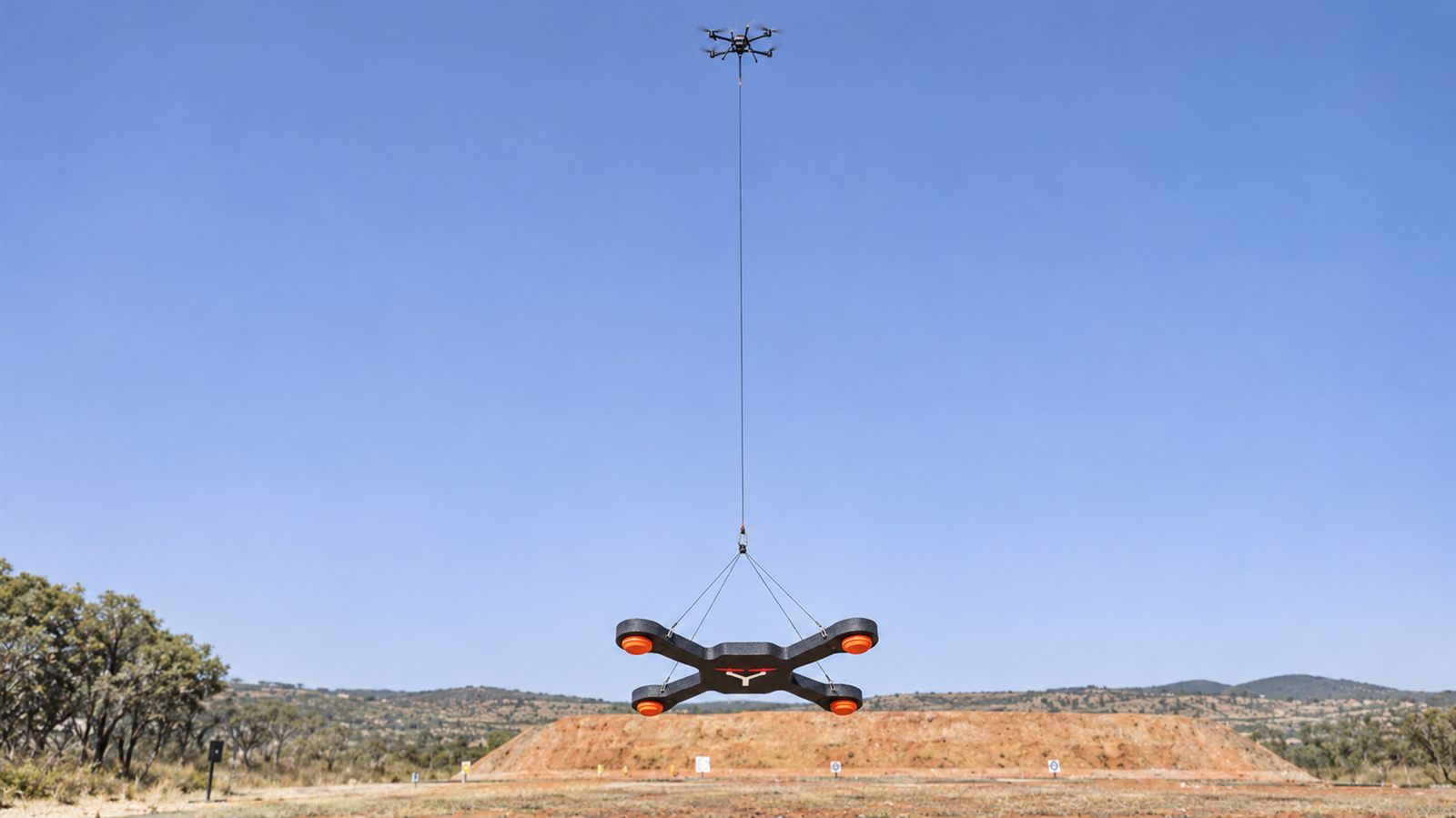 Concept · Lyrebird UST-1 on the range
Clay discs in each arm break visibly on a hit, so the firer and the range staff see it at once, and the arms keep the hits for counting after the serial.
Shot-out arms swap in minutes and the centre is reused, so a range day keeps moving. Each arm is tethered, so a shot-off arm can't fall away.
Built to the size of the drone it represents, from a Mavic 3 (380 mm diagonal) to a Matrice 30T (668 mm wheelbase).
A kill is two or more of the four clays broken, or a hit on the centre, before the target reaches the serial's release line, the point where a real drone would drop or attack.
Concept figures from the design model; the Lyrebird UST-1 is in development. Carried under a drone on a four-point sling; the target's weight counts toward the carrier's.
The UST-1 moves at its carrier's pace. It can't fly a fast attack run or dive at your position. When your shoot needs that, step up to the Lyrebird FPV-1, which flies the real FPV attack and is built to be shot down.
Flies missions planned in Lyrebird Mission Software, by hand, from your own ground station or with mission autonomy. Every behaviour turns away before its target. Other Lyrebirds: Lyrebird FPV-1 · Lyrebird VTW-1 · Lyrebird OWA-1.
 Photo: Spc. Israel Fernandez / U.S. Army National Guard (public domain), cropped
Tell us a little about your training or trials, and what you need to prove, and we'll set up a briefing.
Please don't send classified or sensitive site details by email.